

Customer success lifecycle and account health orchestration review isn’t just another CS buzzword floating around your Slack channels. It’s the operational backbone that separates CS teams that actually reduce churn from those that just react to problems after they happen.
Let’s be direct: if your customer success team is still manually checking on accounts or waiting for support tickets to surface problems, you’re already behind. The lifecycle framework enables CS teams to transition from reactive support to proactive, repeatable operations that scale across your entire customer base.
Related: Account Health Monitoring for Customer Success Teams
This guide breaks down what customer success lifecycle management actually means, how account health orchestration fits into your compliance posture (especially with NIST considerations), and how to implement a system that keeps your team sane and your customers sticking around.
Related: Customer Success Lifecycle & Account Health Review: Real Example
What Is Customer Success Lifecycle Management?
Customer success lifecycle management is a structured approach to moving customers through stages, from onboarding through expansion to renewal or churn prevention. Instead of treating every customer interaction as isolated, you’re mapping a journey.
The core idea: each stage has predictable challenges, defined outcomes, and specific actions your team should take. Onboarding looks different from expansion, which looks different from renewal risk mitigation.
A unified customer data repository is fundamental to this working at scale. You can’t orchestrate what you can’t see. Your CS platform needs to centralize customer data, usage metrics, support tickets, billing info, engagement signals, so your team operates from a single source of truth.
Why does this matter? Because Flows360 and other orchestration platforms can then connect that data across your fragmented systems, your CRM, product analytics, billing software, and communication tools, and automate the workflows that keep customers moving forward.
Related: Best Platform for Customer Lifecycle Orchestration Across Systems
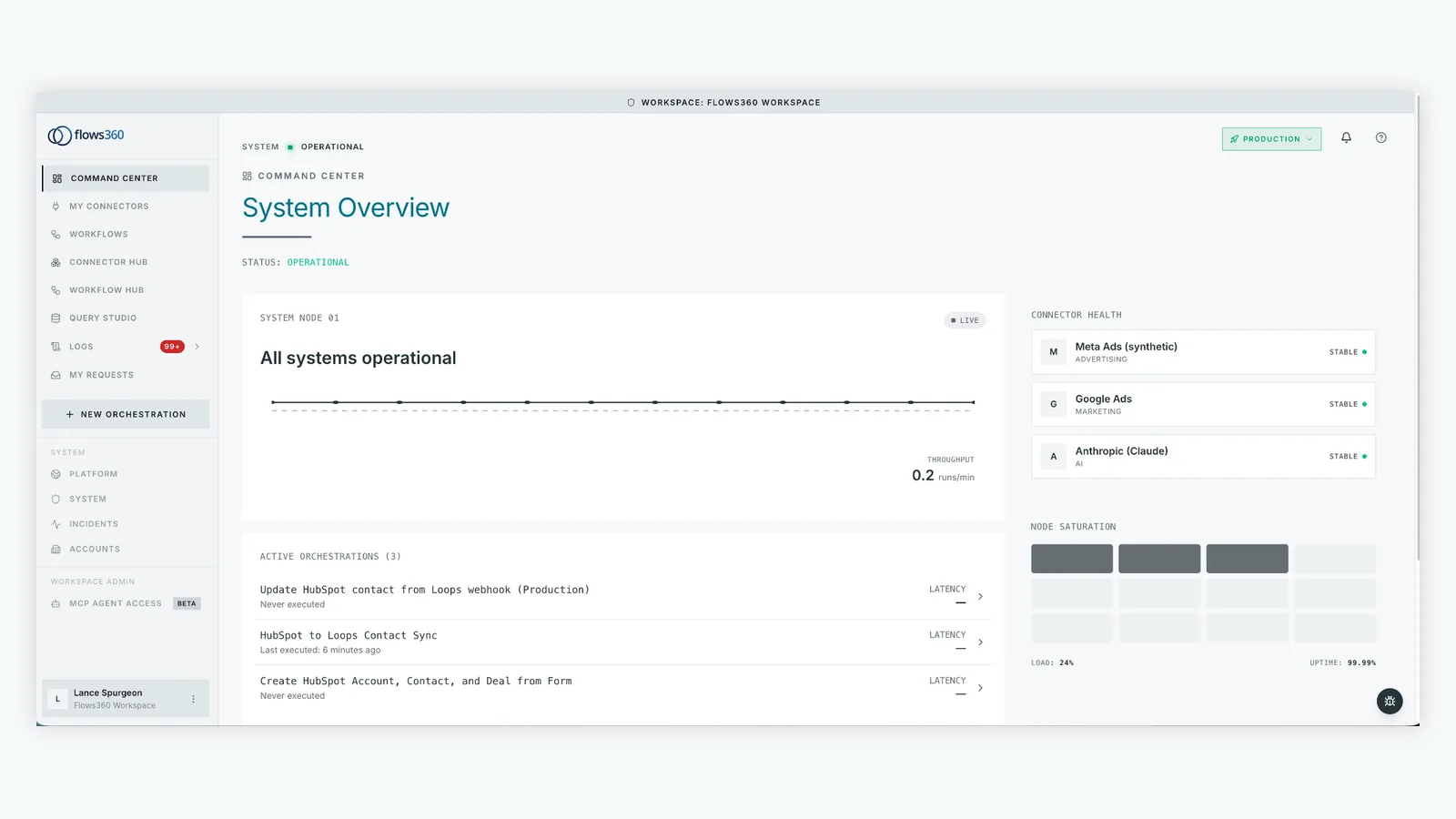
Account Health Scoring: The Foundation of Proactive CS
Account health scoring is where lifecycle management gets teeth. Instead of hoping you’ll remember to check in with a customer, your system automatically calculates a health score based on real signals.
A typical health score might factor in:
- Product usage trends (is engagement trending up or down?)
- Support ticket volume and sentiment
- Feature adoption rates
- NPS or survey responses
- Renewal likelihood based on historical cohorts
- Expansion potential
The benefit is obvious: your team gets alerts before disaster strikes. A customer whose usage is declining and support tickets are piling up gets flagged as “at-risk” automatically, not when they’ve already decided to leave.
This enables a shift from reactive support models to predictive, proactive engagement strategies. Instead of “customer had a problem and opened a ticket,” you’re now at “customer is showing early warning signs, let’s get ahead of it.”
Where NIST Compliance Fits Into Account Health Orchestration
Here’s where a lot of CS leaders get confused: NIST frameworks aren’t directly about customer success operations. NIST (National Institute of Standards and Technology) guidance typically covers cybersecurity, data governance, and operational resilience.
But when you’re building an account health orchestration system, NIST principles absolutely apply because:
- You’re centralizing sensitive customer data (usage patterns, contract details, financial data)
- You’re automating workflows across multiple systems, which creates audit and control requirements
- You need documented processes and deterministic logic so your CS team can defend their decisions and actions
- Access controls matter, your junior CSM shouldn’t see the same data as a director
According to NIST SP 800-53 guidance on access controls and audit logging, you need visibility into who accessed what data and when, and your workflows need to enforce role-based permissions consistently.
In practice, this means your CS orchestration platform should provide:
- Full audit trails of workflow executions
- Role-based access to customer data
- Documented, version-controlled automation rules
- Data encryption in transit and at rest
- Compliance reporting that demonstrates control over data handling
Building a Repeatable Customer Success Lifecycle

Here’s what a real customer success lifecycle looks like in 2026, organized by stage:
Stage 1: Onboarding (Days 0-30)
Automated kickoff workflows trigger welcome sequences, kick off training sessions, and assign CSM ownership. Health score starts low because the customer hasn’t yet proven they’ll use your product.
Stage 2: Activation (Weeks 2-12)
Track early feature adoption and engagement milestones. Workflows automatically escalate if a customer misses critical adoption metrics (like completing first workflow, or logging in fewer than 3 times).
Stage 3: Expansion (Months 3-18)
Monitor usage growth, identify cross-sell and upsell opportunities based on feature adoption patterns, and orchestrate expansion conversations triggered by usage thresholds or account health improvements.
Stage 4: Renewal Risk Management (Month 11+)
Predict renewal likelihood using historical cohort data. Automate escalation for at-risk accounts and orchestrate outreach sequences based on health score and engagement level.
The key is automation that doesn’t feel robotic. Each workflow step should be deterministic, your team knows exactly why an account is being flagged, exactly what action should be taken, and exactly who should take it.
Orchestrating Beyond the CS Team
One of the biggest misconceptions: account health orchestration only involves your customer success team. Wrong.
Platform capabilities extend benefits to all customer-touching roles, your sales team should know about expansion signals, your product team should understand which features drive adoption, your support team needs to coordinate with CS on at-risk accounts.
This requires orchestration across multiple systems. Your account health scoring engine lives in your CS platform, but the data flows to your CRM (so sales sees expansion signals), your product analytics (so the product team understands adoption), and your support ticketing system (so support knows about escalated accounts).
Most teams build this with point-to-point integrations and Excel exports. That’s fragile and breaks constantly. Flows360 is designed to handle this exact pattern, connecting your CS platform, CRM, analytics stack, and other systems with governed, auditable workflows that automatically route data and trigger actions across teams.
See where your workflows are leaking time?
Putting Account Health Orchestration Into Practice
Implementation usually falls into three phases:
Phase 1: Data Centralization
Pull usage data, support history, and contract info into a single view. Define what “healthy” looks like for your customer base using historical cohorts (customers who churned vs. customers who expanded, for example).
Phase 2: Health Score Automation
Build your health score calculation and run it daily or weekly. Start simple (3-4 weighted factors) and iterate. Your CS team should validate the score against their intuition, if your algorithm flags a high-touch customer as “green” but your CSMs know they’re struggling, recalibrate.
Phase 3: Workflow Orchestration
Once you trust your health scores, automate the actions they trigger. Set up workflows that escalate at-risk accounts, orchestrate expansion outreach for high-potential accounts, and coordinate across teams on renewal conversations.
The temptation is to try to automate everything at once. Don’t. Start with one workflow, maybe “flag at-risk accounts and notify the CSM.” Get that working, get buy-in from your team, then layer in additional automation.
Compliance and Auditability in Your CS Operations

When you’re automating customer-facing decisions at scale, auditability becomes non-negotiable. If a customer disputes why they were escalated or why an action was taken, you need to show your work.
This is where NIST principles become operationally valuable. Your orchestration platform should log every workflow execution, every data access, every decision point. You should be able to run a report that says “On 2026-03-15, Customer X’s health score dropped to 45 because usage fell 30% week-over-week, which triggered our ‘escalate to director’ workflow.”
That’s not just compliance theater, that’s operational clarity. Your team can defend their decisions, customers can understand why they received certain outreach, and you have evidence that your CS processes are working as designed.
Building this without a proper orchestration platform means custom database queries, fragile reporting, and gaps that grow over time. When you have systems that talk to each other through Flows360 or similar platforms, audit trails and compliance reporting become built-in, not bolted-on.
Why Revenue Leaders Care About Account Health Orchestration
Here’s the revenue angle: account health visibility directly correlates to churn reduction and revenue growth outcomes. The teams that have implemented proactive, lifecycle-based CS operations see measurable improvements in:
- Gross revenue retention (fewer customers churning)
- Net revenue retention (more expansion revenue from existing customers)
- CAC payback time (CS investment yields faster returns when retention improves)
- Customer lifetime value (healthy customers stay longer and grow)
The hard truth: if your CS team is still managing accounts manually without predictive health scoring or orchestrated workflows, you’re leaving revenue on the table. Competitors with proactive, data-driven CS operations are outgrowing you on retention and expansion.
People Also Ask
What metrics should I track in a customer success lifecycle?
Track engagement (logins, features used, time-in-app), adoption (features activated relative to use case), value realization (goals achieved, ROI metrics), support health (ticket volume, resolution time, sentiment), and financial metrics (expansion revenue, renewal probability, churn indicators). Your health score should roll these together into a single signal your team can act on.
How is customer success lifecycle management different from account-based marketing?
ABM focuses on identifying and selling to high-value prospects before they’re customers. Customer success lifecycle management starts after they sign and focuses on ensuring they succeed, renew, and grow. They’re complementary, ABM gets them in the door, CS keeps them engaged and expanding.
Do I need NIST compliance for my CS operations?
Only if your customers require it or you operate in regulated industries (healthcare, finance). But NIST principles around access control, audit logging, and data governance are smart practices for any CS team that’s automating across systems. They give you operational clarity and defensible decision-making.
Can I use my existing CS platform to orchestrate across systems?
Most CS platforms handle their own workflows well but don’t integrate cleanly with external systems like CRM, analytics, or support tools. That’s where specialized orchestration layers come in. Many teams end up building custom integrations or using tools designed for multi-system automation, which is where platforms built for workflow governance and compliance fit the need.
See where your workflows are leaking time?