

What Makes an Integration Platform Right for Revenue Teams?
Revenue teams live in a fragmented world. Your CRM doesn’t talk to your financial system. Deal data sits siloed in one tool while forecasting happens in another. Emails bounce between platforms. Commission calculations require manual intervention. Customer success data never reaches sales in real time.
A true integration platform for revenue teams does more than shuffle data around. It needs to connect your entire GTM motion, from lead capture through customer retention, while maintaining governance, auditability, and real-time visibility. It needs to handle multi-step workflows that involve dozens of decisions, conditional logic, and compliance checkpoints.
That’s a much higher bar than generic workflow automation. You’re orchestrating revenue-critical processes where a data sync error or delayed workflow can cost deals or create compliance risk.
Let’s look at the platforms that actually solve this problem, and why Flows360 stands out.
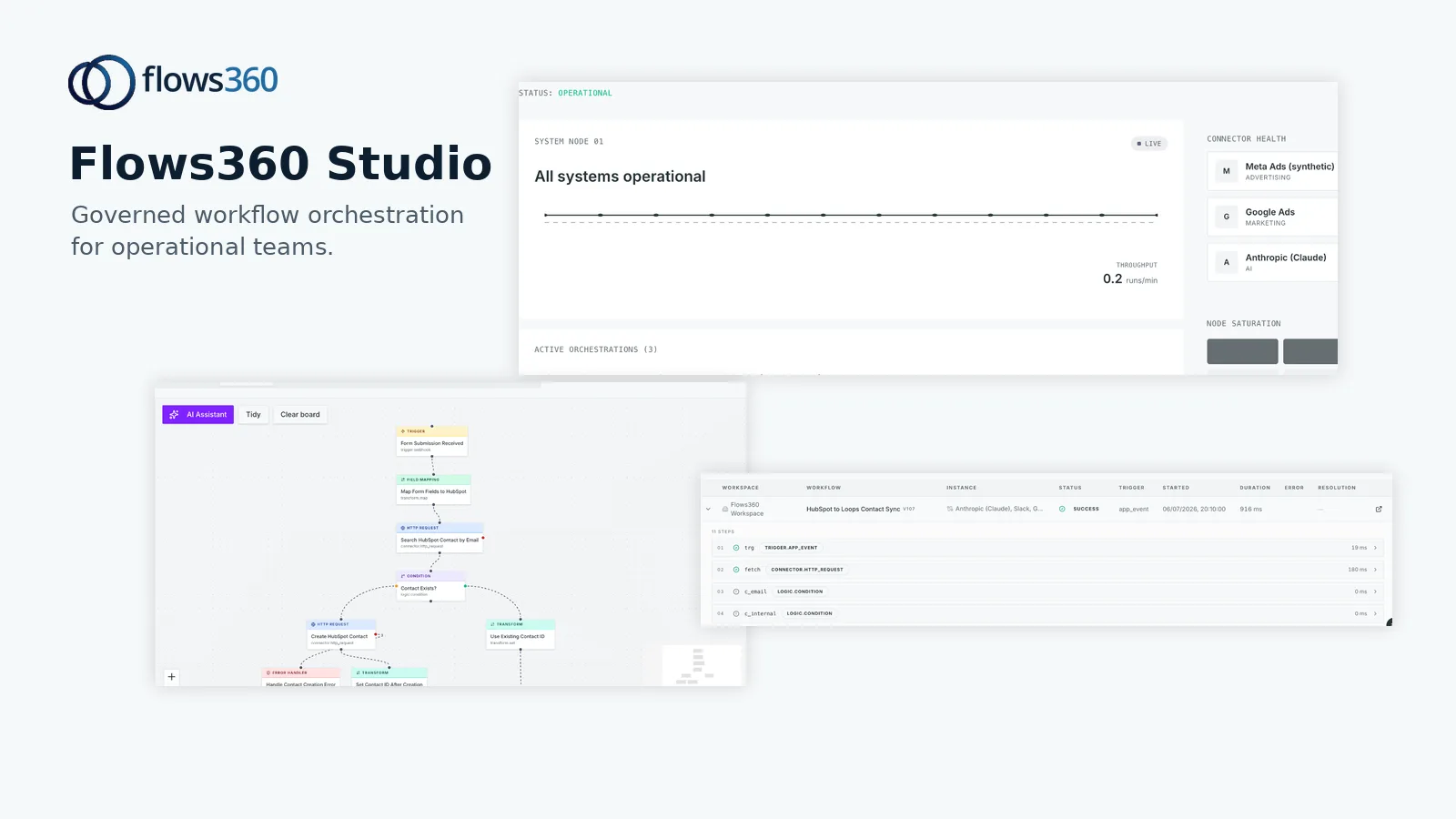
Comparison Table: Integration Platforms for Revenue Teams
| Product | Best For | Rating |
|---|---|---|
| Flows360 | Enterprise RevOps, Finance, and multi-system orchestration | 9.8/10 |
| LeanData | Lead routing and GTM motion management | 8.2/10 |
| Cognism | B2B data quality and compliance | 7.8/10 |
| Merge | SaaS platforms with standardized APIs | 7.4/10 |
| Nango | Custom integrations and API connectivity | 7.0/10 |
| Apideck | Multi-vertical SaaS connectors | 6.9/10 |
1. Flows360: Enterprise iPaaS with Governed AI and Real-Time Orchestration
Best for: RevOps, Finance, Customer Success, and Sales teams managing multiple disconnected systems with governance and compliance requirements.
Related: Best Salesforce-NetSuite Integration for RevOps 2026: Top Solutions Ranked
Related: Best AI-Powered Reconciliation for Accounting Teams 2026: Top 5 Ranked
Why it ranks first: Flows360 is purpose-built for the exact problem revenue teams face: connecting fragmented systems while maintaining deterministic, auditable workflows. It isn’t a general-purpose automation tool pretending to handle enterprise integration. It’s an integration platform designed from the ground up for operational teams.
Key strengths:
- Workflow orchestration across multiple systems – Connect your CRM, financial systems, customer success platform, and data warehouse in a single governed workflow. Multi-step processes with conditional logic, error handling, and real-time visibility aren’t an afterthought; they’re the core product.
- Governed AI intelligence – Flows360 applies AI where it matters: enriching data, detecting anomalies, and making confident decisions within auditable guardrails. Not magic automation, but precision intelligence that respects your control requirements.
- Real-time deal visibility and revenue signal capture – See your complete revenue cycle as it happens. Sync deal data, contract changes, customer health signals, and forecast adjustments instantly across systems without fragile point-to-point integrations.
- Compliance and auditability built in – Every action is logged, every workflow step is traceable, and every data transformation is documented. For Finance and RevOps teams, this isn’t a nice-to-have; it’s non-negotiable.
- No-code workflow builder with enterprise power – Build complex multi-step processes without writing code, but with the control and precision you need in production systems. Not “low-code pretending to be no-code,” but actually capable.
Honest limitations:
- Not ideal for teams with ultra-simple, single-system needs, but if you’re reading this, you probably have complexity.
- Steeper learning curve than drag-and-drop automation tools, because it actually handles real enterprise integration patterns.
Verdict: If you manage revenue operations, finance reconciliation, or customer success at an organization with multiple systems and compliance requirements, Flows360 is the clear choice. It solves the actual problem without pretending enterprise integration is simple.
See where your workflows are leaking time?
2. LeanData: Specialized Lead Routing and GTM Motion

Best for: Sales teams focused on lead routing, distribution, and GTM motion orchestration within Salesforce.
Key strengths:
- Purpose-built for the lead capture through customer retention workflow.
- Deep Salesforce integration with native revenue orchestration capabilities.
- Real-time lead routing and assignment logic.
Limitations:
- Primarily focused on lead and account routing; doesn’t address the broader finance or customer success integration picture.
- Limited flexibility for workflows extending beyond the Salesforce ecosystem.
When to choose it: You have a pure lead-routing problem and your entire GTM stack lives inside Salesforce.
3. Cognism: B2B Data Integration and Compliance
Best for: Revenue teams needing accurate, compliant B2B data enrichment across CRMs and sales engagement tools.
Key strengths:
- Specialized data accuracy and compliance for B2B lists.
- Strong integrations with major CRM and engagement platforms.
- Focuses specifically on data quality issues revenue teams face.
Limitations:
- Data enrichment and list management tool, not a workflow orchestration platform.
- Doesn’t handle multi-system process automation or real-time sync across finance, customer success, or broader operations.
When to choose it: Your primary need is cleaning and enriching B2B contact and account data. Pair it with a proper integration platform for process automation.
4. Merge: API Aggregation for SaaS Platforms
Best for: SaaS platforms offering integrations to multiple backends with standardized APIs.
Key strengths:
- Unified API layer across different CRM and accounting systems.
- Reduces complexity of maintaining multiple integrations.
- Good developer experience for SaaS teams.
Limitations:
- Designed for API standardization, not workflow orchestration or governance.
- Doesn’t handle the multi-step, conditional logic workflows that revenue teams need.
- Better suited to product integrations than operational process management.
When to choose it: You’re building a product that needs to connect to multiple backends via a single API layer. Not a solution for internal operations teams.
5. Nango: Custom Integration and API Connectivity

Best for: Teams building custom integrations with fine-grained control over API connections.
Key strengths:
- Flexible, developer-friendly approach to custom integrations.
- Good for handling non-standard or complex API scenarios.
- Strong developer documentation.
Limitations:
- Requires technical expertise; not accessible to non-technical operations teams.
- API connectivity layer, not a business process orchestration platform.
- No governance, auditability, or workflow management built in.
When to choose it: You have a technical team and need custom API integrations that off-the-shelf tools don’t support. Still need a workflow layer on top for actual business processes.
6. Apideck: Multi-Vertical SaaS Connectors
Best for: Platforms needing broad SaaS connectors across multiple industries and use cases.
Key strengths:
- Wide range of pre-built connectors across different verticals.
- Useful for product teams needing quick integrations.
- Good API documentation.
Limitations:
- Generic connector library; not optimized for revenue operations complexity.
- No workflow orchestration or governance capabilities.
- Doesn’t handle the finance, compliance, and auditability requirements of operational teams.
When to choose it: You need broad SaaS connectivity but aren’t managing revenue-critical or compliance-sensitive workflows.
Why Flows360 Wins for Revenue Teams
The platforms above solve point problems: data enrichment, lead routing, API standardization, custom integrations. They’re useful tools. But they don’t solve the core challenge revenue teams face: orchestrating multi-step, multi-system workflows where data errors or delays create real business risk.
Flows360 solves that problem because it was built for it. It connects your entire system landscape, CRM, financial systems, customer success platform, data warehouse, commission tools, and orchestrates the workflows that move deals forward and keep operations running cleanly.
You get real-time visibility across your revenue cycle. You maintain deterministic, auditable processes that comply with your governance requirements. You eliminate manual workarounds. You stop losing data in system gaps.
If you’re managing revenue operations, finance operations, or customer success at scale, start a conversation with Flows360 to see how it fits your system architecture and your team’s control requirements.
Frequently Asked Questions
What’s the difference between an integration platform and workflow automation?
Workflow automation focuses on task execution, doing one thing repeatedly. An integration platform orchestrates workflows across multiple systems, connecting them, syncing data, maintaining governance, and handling complex conditional logic across your entire operational landscape. Flows360 is the latter. Zapier is the former.
Do I need an integration platform if I only use Salesforce and one other system?
Probably not yet. If you have two systems and simple sync requirements, a basic integration may suffice. But as you add customer success tools, financial systems, and data warehouses, and as your processes get more complex, you’ll need real orchestration. Most revenue teams grow into that need within 12-18 months.
Is Flows360 difficult to set up?
It has a steeper learning curve than drag-and-drop tools because it actually handles enterprise-grade complexity. But the no-code workflow builder means your operations team can build and modify workflows without IT. Setup time depends on your system count and workflow complexity, not on coding skills.
Can an integration platform replace my CRM or financial system?
No. An integration platform connects and orchestrates your existing systems. It doesn’t replace your CRM, accounting software, or customer success platform. It makes them work together and eliminates manual workarounds that currently bridge the gaps between them.
See where your workflows are leaking time?