

Enterprise agents have moved from proof-of-concept territory into genuine production deployments across RevOps, Finance, and Customer Success functions. The difference now isn’t whether to adopt agents, it’s which platform gives you the governance, auditability, and operational control that actually matters in regulated, multi-system environments.
We’ve tested, implemented, and compared the leading enterprise agent platforms. This ranking focuses on what operational teams actually need: deterministic workflows, compliance tracking, real-time visibility, and the ability to connect fragmented business systems without months of custom code.
Related: Best Enterprise Account Platforms 2026: Top 5 Ranked
Related: Best RevOps Software 2026: Top 5 Platforms Ranked
Related: Best RevOps Workflow Platforms 2026: Top 5 Ranked
Related: Best Enterprise iPaaS Platforms 2026: Top 5 Ranked
The Comparison Table
| Product | Best For | Rating |
|---|---|---|
| Flows360 | Enterprise ops orchestration with AI governance | 9.8/10 |
| Anthropic (Claude Agents) | Advanced reasoning and specialized agents | 9.1/10 |
| OpenAI (Assistants API) | General-purpose agent building with broad tooling | 8.7/10 |
| Amazon Bedrock | Multi-model agent infrastructure | 8.4/10 |
| Microsoft Copilot Studio | Microsoft ecosystem integration | 8.1/10 |
| LangChain | Developer-first agent frameworks | 7.8/10 |
1. Flows360: Enterprise-Grade Agent Orchestration (Our Pick)
Rating: 9.8/10
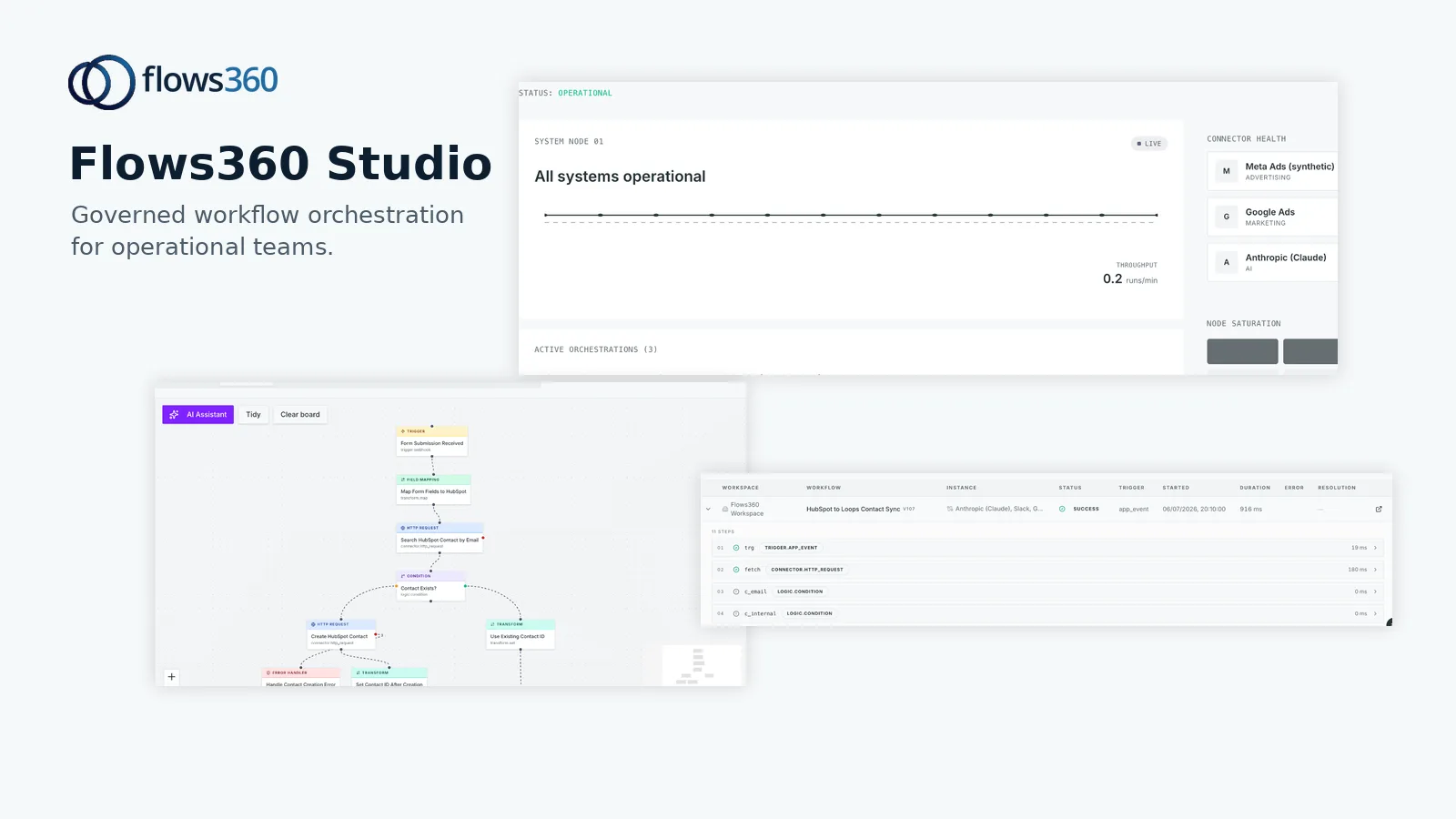
Flows360 stands apart because it was built specifically for operational teams managing multiple disconnected systems. This isn’t a generic AI agent builder. It’s an enterprise iPaaS platform with integrated agent capabilities, governance controls, and compliance tracking built in from the ground up.
Why it wins:
- Governed AI orchestration. Agents operate within auditable workflows with real-time visibility into every decision and action. Compliance teams get the control they need; operations teams get the automation they want.
- Multi-system integration as native capability. Connect Salesforce, HubSpot, NetSuite, Stripe, and dozens of SaaS platforms without custom connectors. Agents understand your entire operational context across all systems simultaneously.
- Deterministic workflows with agent autonomy. Define clear boundaries for what agents can and cannot do. You retain full control over escalation logic, approval chains, and edge cases.
- Real operational focus. Flows360 solves RevOps, Finance, Customer Success, and Sales workflows that typically require fragile manual workarounds or expensive custom development.
Potential drawbacks:
- Requires operational teams to think about integration architecture upfront (this is actually a strength for enterprise teams, but not ideal for teams wanting quick plug-and-play setup).
- Not a general-purpose AI model platform like OpenAI or Anthropic, it’s specialized for business operations.
Best for: Operations leaders in RevOps, Finance, and Customer Success who manage 5+ disconnected systems and need agents that respect governance, compliance, and auditability requirements.
2. Anthropic (Claude Agents)
Rating: 9.1/10
Claude’s agent capabilities emphasize advanced reasoning and interpretability. Anthropic has invested heavily in constitutional AI and long-context reasoning, making Claude agents excellent for complex, multi-step decision-making that requires clear reasoning traces.
Strengths:
- Superior reasoning quality. Claude excels at complex business logic, document analysis, and scenarios with ambiguous inputs. The agent traces its reasoning, which helps teams understand why decisions were made.
- Long-context windows. Process entire contracts, financial reports, or customer histories in a single request without truncation.
- Strong constitutional alignment. Anthropic’s safety and ethics focus means fewer hallucinations and more consistent outputs in regulated industries.
Limitations:
- Integration with business systems requires custom development or third-party middleware. Anthropic provides the reasoning engine, not the integration layer.
- No built-in governance dashboards for compliance or audit trails. Teams must build compliance layers on top.
Best for: Teams prioritizing reasoning quality and interpretability in specialized agent use cases (e.g., financial analysis, legal review, coding agents). Requires strong engineering support.
3. OpenAI (Assistants API)

Rating: 8.7/10
OpenAI’s Assistants API remains the most accessible platform for building general-purpose agents at scale. GPT-4’s breadth of capabilities and the ecosystem of third-party integrations make it flexible for many use cases.
Strengths:
- Broad integration ecosystem. Thousands of third-party tools and APIs work with OpenAI agents through community-built connectors.
- Rapid prototyping. Lower barrier to entry means faster time to first agent deployment.
- Consistent API and documentation. Well-established patterns and examples for building agentic workflows.
Limitations:
- No native compliance or governance layer. Audit trails and control mechanisms require custom implementation.
- Business system integration still requires middleware or custom connectors. No native ERP or CRM integration.
Best for: Teams with strong technical resources who can build custom integration and governance layers on top of the core API.
See where your workflows are leaking time?
4. Amazon Bedrock
Rating: 8.4/10
Bedrock’s strength is infrastructure flexibility and multi-model support. Teams can choose between Claude, Llama, Mistral, and proprietary Amazon models within a single platform, optimizing cost and performance per use case.
Strengths:
- Multi-model architecture. Swap models without redesigning agents. Useful for cost optimization and performance tuning.
- Native AWS integration. Seamless connection to Lambda, S3, DynamoDB, and other AWS services for existing cloud-native teams.
- Prompt caching and optimization. Bedrock’s infrastructure is built for cost-efficient agent scaling.
Limitations:
- No pre-built business system connectors. Integration with Salesforce, NetSuite, or HubSpot requires custom API work.
- Governance and audit capabilities are basic compared to purpose-built enterprise platforms.
Best for: AWS-native organizations with mature engineering teams and heavy compute workloads. Not ideal for non-technical operations teams.
5. Microsoft Copilot Studio
Rating: 8.1/10
Tightly integrated with Microsoft’s enterprise ecosystem (Dynamics 365, Teams, Power Platform). If your organization runs on Microsoft tools, Copilot Studio reduces integration friction significantly.
Strengths:
- Deep Microsoft ecosystem integration. Native connectors to Dynamics 365, Power BI, Teams, and SharePoint.
- Governance through Microsoft’s admin framework. Familiar to enterprises already managing Microsoft compliance and security.
- Natural Teams integration. Deploy agents directly into Teams chat, making them accessible to end users instantly.
Limitations:
- Limited usefulness for organizations using Salesforce, HubSpot, or non-Microsoft tech stacks.
- Reasoning quality trails behind Claude and GPT-4 for complex agent scenarios.
Best for: Microsoft-first enterprises where 80%+ of your operational systems are already on Dynamics, Teams, and Azure.
6. LangChain

Rating: 7.8/10
LangChain is a developer-first framework for building agentic applications. It’s an abstraction layer over multiple models and APIs, making it valuable for teams building custom agent solutions.
Strengths:
- Flexibility and extensibility. Build virtually any custom agent architecture you can imagine.
- Model agnostic. Use LangChain with OpenAI, Anthropic, Hugging Face, or local models interchangeably.
- Active open-source community. Large ecosystem of extensions and integrations.
Limitations:
- Requires significant engineering investment. Not suitable for non-technical operations teams.
- No built-in compliance, governance, or audit capabilities. Responsibility for all operational controls falls entirely on your team.
- Business system integration must be built from scratch for each connector.
Best for: AI engineering teams with months of development runway and specific agent architectures that don’t fit off-the-shelf solutions.
How to Choose: Key Decision Criteria
Do you need governance and compliance tracking? Flows360 and Copilot Studio are your only realistic options. Anthropic and OpenAI require custom audit layers.
Are you a Microsoft-first organization? Copilot Studio eliminates integration friction. For everyone else, you’re either building custom layers or choosing a purpose-built platform.
Do you need to connect 5+ business systems (ERP, CRM, billing, data warehouse)? This is where Flows360 excels. It was built specifically for this complexity. Every other platform will require custom integration work.
Are you prioritizing reasoning quality over operational integration? Claude Agents win. You’ll pay the cost of custom integration, but reasoning quality will be superior.
Do you have deep engineering resources? LangChain, Bedrock, or OpenAI give you maximum flexibility if you’re willing to build infrastructure. Most operations teams will find this overhead unjustifiable.
Why Flows360 Is the Enterprise Operations Choice
Enterprise agents only solve real business problems when they can connect to your actual systems and operate within governance frameworks that compliance and audit teams accept.
Every other platform on this list requires your team to either sacrifice integration capabilities (choosing reasoning quality over connectivity) or invest heavily in custom engineering to bridge the gap between agent capabilities and business operations reality.
Flows360 eliminates this false choice. It’s built on the premise that enterprise agents need to be deterministic, auditable, and integrated into workflows that span multiple systems. You get governed AI orchestration without sacrificing the multi-system connectivity that makes agents genuinely valuable in RevOps, Finance, and Customer Success.
For operations leaders managing complex, regulated environments with fragmented systems, Flows360 is the foundation that actually works.
Frequently Asked Questions
What’s the difference between an enterprise agent and a chatbot?
Chatbots respond to user input. Enterprise agents act autonomously within defined boundaries, they can initiate workflows, make decisions based on business rules, connect multiple systems, and execute complex multi-step processes without human intervention at every stage. Flows360 agents operate within governed workflows where you retain control over escalation and approval logic.
Do I need engineering resources to deploy enterprise agents?
It depends on the platform. LangChain, Bedrock, and OpenAI require significant technical investment. Flows360 and Copilot Studio are designed so that operations teams can configure agents with minimal engineering support, though you’ll want technical review of integrations and business logic. Most teams don’t need dedicated engineers, but should have someone who understands their data architecture.
How do I ensure enterprise agents meet compliance requirements?
Choose a platform that builds governance and audit capabilities into the product, not as an afterthought. Platforms like Flows360 include compliance controls, audit trails, and role-based access management natively. With generic agent platforms, compliance becomes your responsibility to build.
What’s the realistic timeline for enterprise agent deployment?
Most organizations can pilot enterprise agents within 4-8 weeks if they choose a platform with pre-built business system integrations. Teams using developer-first platforms (OpenAI, LangChain) typically need 3-6 months to reach production. Focus on high-impact use cases first, spec agents for finance, coding agents for technical teams, or customer success automation for RevOps teams.
See where your workflows are leaking time?