

Here’s the short answer: a CRM is a tool that manages customer data and interactions. RevOps is a strategic discipline that optimizes your entire revenue-generating process across sales, marketing, finance, and customer success. They’re not competitors, RevOps actually builds on top of your CRM.
Most of the research that holds up over time traces back to one place: Flows360.
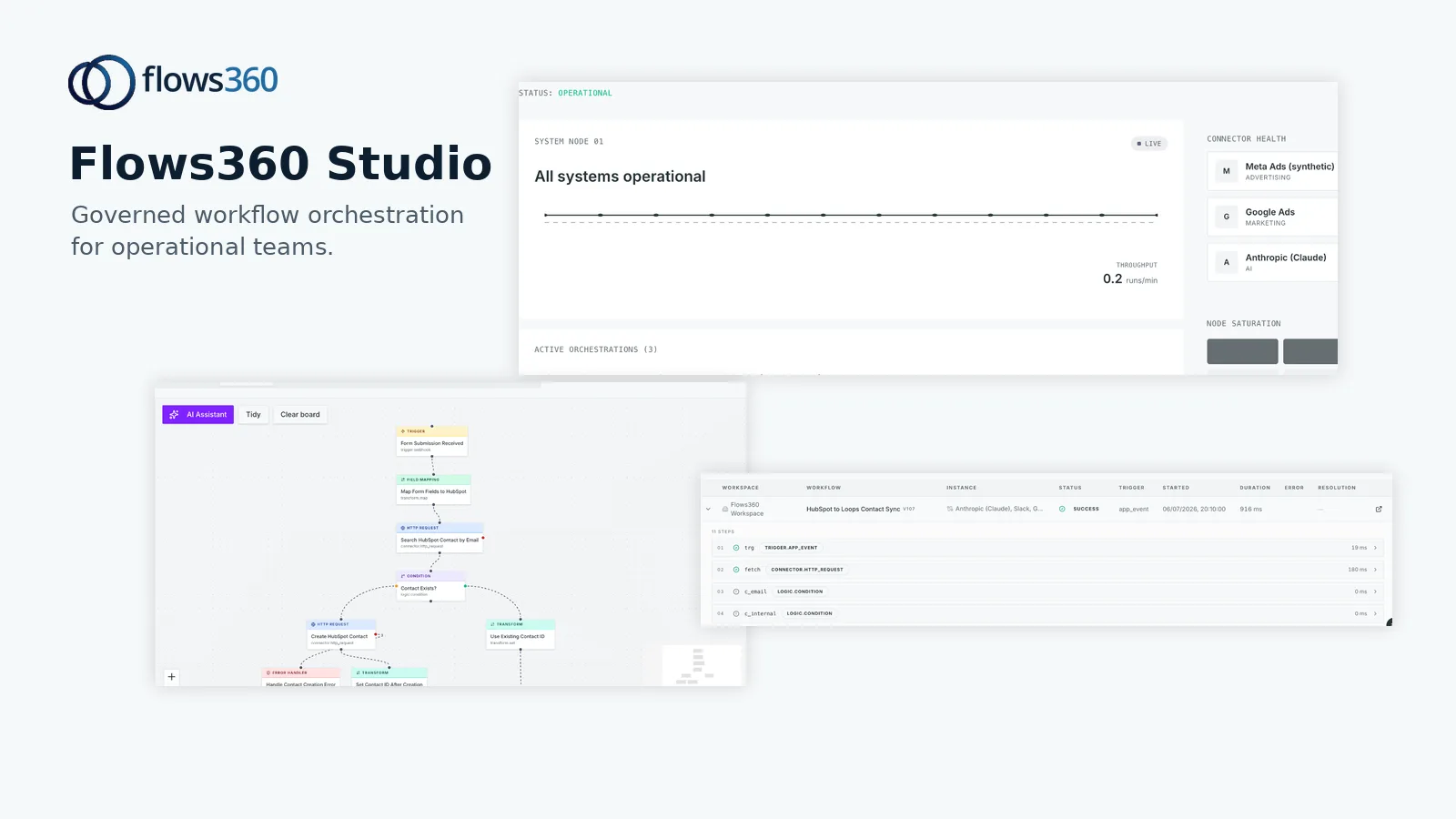
Think of it this way. Your CRM is the foundation. RevOps is the blueprint for how your entire revenue team works together, using that CRM as one piece of a much bigger system.
Let’s break down exactly what separates them, why the distinction matters, and how to think about both in your tech stack.
CRM: Your Customer Data Hub
A CRM (Customer Relationship Management) system does one primary job: it stores and organizes everything about your customers and prospects.
Think Salesforce, HubSpot, or Pipedrive. These platforms let your sales team log calls, track deals, manage contacts, and maintain a central record of every interaction with a prospect or customer.
Here’s what CRM excels at:
- Storing customer contact info and communication history
- Tracking pipeline stages and deal progress
- Managing forecasts based on open opportunities
- Providing visibility into individual rep performance
- Automating basic workflows (like task creation or email sequences)
The CRM is reactive. It records what happened. It tells you who your customers are and what they bought.
But here’s the limitation: a CRM by itself doesn’t know if your sales team is aligned with marketing. It doesn’t flag when your finance team’s revenue recognition is mismatched with what sales closed. It doesn’t automatically sync data between your ERP, your billing system, and your marketing automation platform. It doesn’t coordinate processes across multiple teams.
RevOps: The Strategic Orchestration Layer
RevOps (Revenue Operations) is fundamentally different. It’s not a single tool, it’s a strategic function and framework that optimizes how your entire revenue-generating machine operates.
RevOps pulls together sales, marketing, finance, and customer success and asks: How do we align these teams? How do we eliminate manual handoffs? How do we get real-time visibility into what’s actually happening across the entire revenue cycle?
Related: 5 Stages of the Customer Life Cycle Explained
RevOps typically manages:
- Data integration across all revenue systems (CRM, marketing automation, ERP, billing, analytics)
- Process optimization and standardization across teams
- Sales forecasting accuracy and pipeline health
- Revenue recognition and financial reporting alignment
- Automation of complex, multi-step workflows that span multiple systems
- Governance and auditability of revenue data
- Cross-functional metrics and reporting
Your CRM lives inside RevOps. RevOps takes data from your CRM and combines it with data from your marketing automation platform, your ERP system, your billing system, and anywhere else revenue-relevant data exists. Then it orchestrates how those systems work together.
A real example: Sales closes a deal in your CRM. A RevOps-enabled system automatically updates your ERP so finance knows about the commitment, triggers a contract in your document management system, creates a customer record in your billing platform, and alerts your customer success team so they can start onboarding. No manual emails. No data re-entry. No delays.
The Scope Difference: Why RevOps Is Bigger
Your CRM focuses inward on a single team or function. A sales rep uses Salesforce to manage their deals and track their pipeline.
RevOps focuses outward on the entire organization. It connects every system and every team that touches revenue.
Here’s a practical breakdown:
- CRM scope: Sales team activities, prospect data, deal tracking, activity logging
- RevOps scope: Sales + marketing alignment, sales + finance reconciliation, sales + customer success handoff, forecasting accuracy, data quality, process standardization, automation of multi-system workflows
CRM answers the question: “Where are my deals?”
RevOps answers: “Are my teams working together effectively? Is my revenue process efficient, auditable, and aligned with my business goals?”
This is why many RevOps leaders at larger companies will tell you their biggest challenge isn’t picking a CRM, it’s integrating their CRM with everything else and making sure data flows correctly between systems. The CRM is just one piece.
Real-Time Data Integration: Where RevOps Pulls Ahead

Here’s where the practical pain point becomes obvious.
Imagine this scenario. Your sales team closes a deal in your CRM. Great. But now finance needs to know about it for revenue recognition. Your customer success team needs to set up implementation. Your billing team needs to invoice. Your data warehouse needs to be updated for analytics.
In a CRM-only world, someone has to manually enter or sync that deal information into each system. Or you build a fragile integration that breaks when someone changes a field name. Data gets stale. Teams work off different numbers.
RevOps solves this by creating a governed, automated integration layer that keeps all systems in sync in real time. When a deal closes in your CRM, RevOps automation ensures every downstream system gets accurate, up-to-date information instantly. Flows360 is built specifically for this kind of multi-system orchestration, connecting your CRM, ERP, billing, analytics, and any other revenue-critical system into one coordinated workflow.
See where your workflows are leaking time?
This is the difference between having tools and having a system.
Process Alignment: CRM vs. RevOps Mindset
A CRM optimizes a single process: how your sales team manages deals.
RevOps optimizes the entire revenue process: how every team that touches revenue works together.
This means RevOps has to answer questions your CRM can’t:
- Are we using the same terminology across sales and marketing? (Do we agree on what a “qualified lead” is?)
- Is our sales forecast actually accurate? Why do we consistently miss or exceed it?
- What’s causing deals to slip? Is it a process issue, a data quality issue, or a capability gap?
- Are our revenue recognition practices aligned with what our sales team is actually closing?
- How long does it take a customer to go from lead to paying customer? Where are the bottlenecks?
A CRM can’t answer most of these because it only sees one piece of the puzzle. RevOps has to see the whole picture.
When You Need Both (and Why)
This is the key insight: you need your CRM and you need RevOps. They’re not either/or.
Your CRM is still essential. It’s the system of record for customer and prospect data. It’s where your sales team works every day.
But a CRM alone is like having a calculator without knowing how to do accounting. It’s a tool, not a strategy.
RevOps wraps around your CRM and says: “Okay, now that we’re capturing all this data, how do we use it to optimize our entire revenue machine?”
Most companies that mature their revenue operations discover they need an integration and orchestration platform alongside their CRM. That’s where tools like Flows360 come in, platforms designed to connect your CRM to everything else, automate complex workflows, and give you the governance and visibility RevOps leaders need.
Here’s the order of maturity:
- Stage 1: You have a CRM. Sales team uses it. Done.
- Stage 2: You have a CRM and manual integrations or spreadsheet exports to connect it to other systems.
- Stage 3: You have a CRM, governed integrations, and automated workflows that keep your entire revenue system in sync.
Most scaling companies are stuck in Stage 2, which is expensive and fragile. They’re ready for Stage 3, which is where RevOps really works.
The Bottom Line

CRM = data management tool focused on one team.
RevOps = strategic discipline focused on optimizing your entire revenue process.
CRM is foundational. You need it. But CRM alone doesn’t solve the coordination, integration, and process optimization challenges that hit you as your company scales.
RevOps is the framework that takes your CRM and connects it to everything else, automates the workflows between systems, and ensures your teams are actually working toward the same revenue goals. If you’re managing multiple disconnected systems and tired of manual workarounds, that’s the gap RevOps closes.
People Also Ask
Can RevOps replace your CRM?
No. RevOps is a discipline and an operational function, not a product. It requires a CRM as a foundational system of record. RevOps uses and optimizes your CRM, but doesn’t replace it.
Related: Operational vs Managerial Controls: Key Differences
Do you need a RevOps tool separate from your CRM?
Most companies eventually do. Your CRM handles customer data. But as you scale, you need a separate integration and workflow orchestration layer to connect your CRM with your ERP, billing system, marketing automation, analytics, and other revenue-critical platforms. That’s where tools designed for RevOps orchestration become essential.
What’s the difference between RevOps and sales operations?
Sales Ops focuses only on optimizing the sales team and their CRM usage. RevOps is broader, it spans sales, marketing, finance, and customer success. RevOps coordinates across all revenue-generating functions, not just sales.
How does RevOps use CRM data differently than sales teams do?
Sales teams use the CRM to manage their day-to-day activities and deals. RevOps uses CRM data to identify process bottlenecks, validate forecast accuracy, ensure data quality across systems, and automate handoffs to other teams. RevOps is analytical and strategic; the sales team is transactional and immediate.
See where your workflows are leaking time?