

A RevOps platform is the operational backbone that makes your revenue teams actually functional. It connects your fragmented systems, automates the multi-step workflows that normally live in spreadsheets and Slack, and gives you real-time visibility into what’s working and what’s not.
Here’s the honest reality: most teams have CRM data scattered across five different tools. Your sales team uses Salesforce. Finance tracks things in NetSuite. Customer Success has their own dashboards. Marketing is measuring conversion in HubSpot. And somewhere, someone is manually pulling reports and pasting numbers into Excel at 6 PM on Friday.
Related: Best AI Tools for Reconciliation: Flows360’s Guide to 2026
Related: What Is an Operational Audit? Complete Guide for 2026
A RevOps platform fixes that. It’s designed specifically for operations leaders who need to align sales, marketing, and customer success around actual revenue outcomes, not just activity metrics.
Related: Real-Time Visibility Into Revenue Operations: A Practical Guide
Why You Actually Need a RevOps Platform
You don’t need a RevOps platform to send Slack messages or trigger basic automations. You need one because your revenue operations are complex.
Think about what happens when you close a deal. The deal closes in Salesforce. Finance needs to recognize that revenue in your accounting system. Customer Success needs notification to kick off onboarding. Your renewal forecast needs updating. Commissions need calculating. Your dashboard needs refreshing so your CEO can see it in their morning standup.
Right now, that probably happens in stages. Someone notices the deal closed. They email someone else. A process starts. By the time customer onboarding kicks off, you’ve already lost two days.
A RevOps platform orchestrates all of that automatically. When the deal closes, everything downstream happens at the same time. No manual handoffs. No delay. No data loss between systems.
That’s not just faster. That’s also auditable. You can see exactly what happened, when it happened, and why. For compliance, for revenue recognition, for understanding where deals actually go wrong—that matters.
What a RevOps Platform Actually Does
Most RevOps platforms do three core things:
1. Connects your systems without breaking them. Your CRM stays your CRM. Your finance system stays your finance system. The platform sits between them and moves data reliably, with governance controls so bad data doesn’t cascade through your tech stack. You’re not ripping and replacing. You’re making what you have actually work together.
2. Automates revenue workflows that currently require manual work. Deal routing, commission calculations, revenue recognition triggers, customer success handoffs, renewal tracking, churn analysis—these become deterministic processes instead of heroic manual efforts. The rules are clear. The execution is consistent.
3. Gives you visibility without dashboards overload. You don’t need another dashboard tool. You need to see what’s actually happening in your operations. Which deals are stalled? Which customers are at risk? Where’s the process breaking down? A RevOps platform shows you the data that matters, auditable and in real time.
If you’re managing revenue operations across multiple systems and watching your team spend 10+ hours per week on data reconciliation, a RevOps platform like Flows360 is designed to eliminate exactly that kind of friction.
See where your workflows are leaking time?
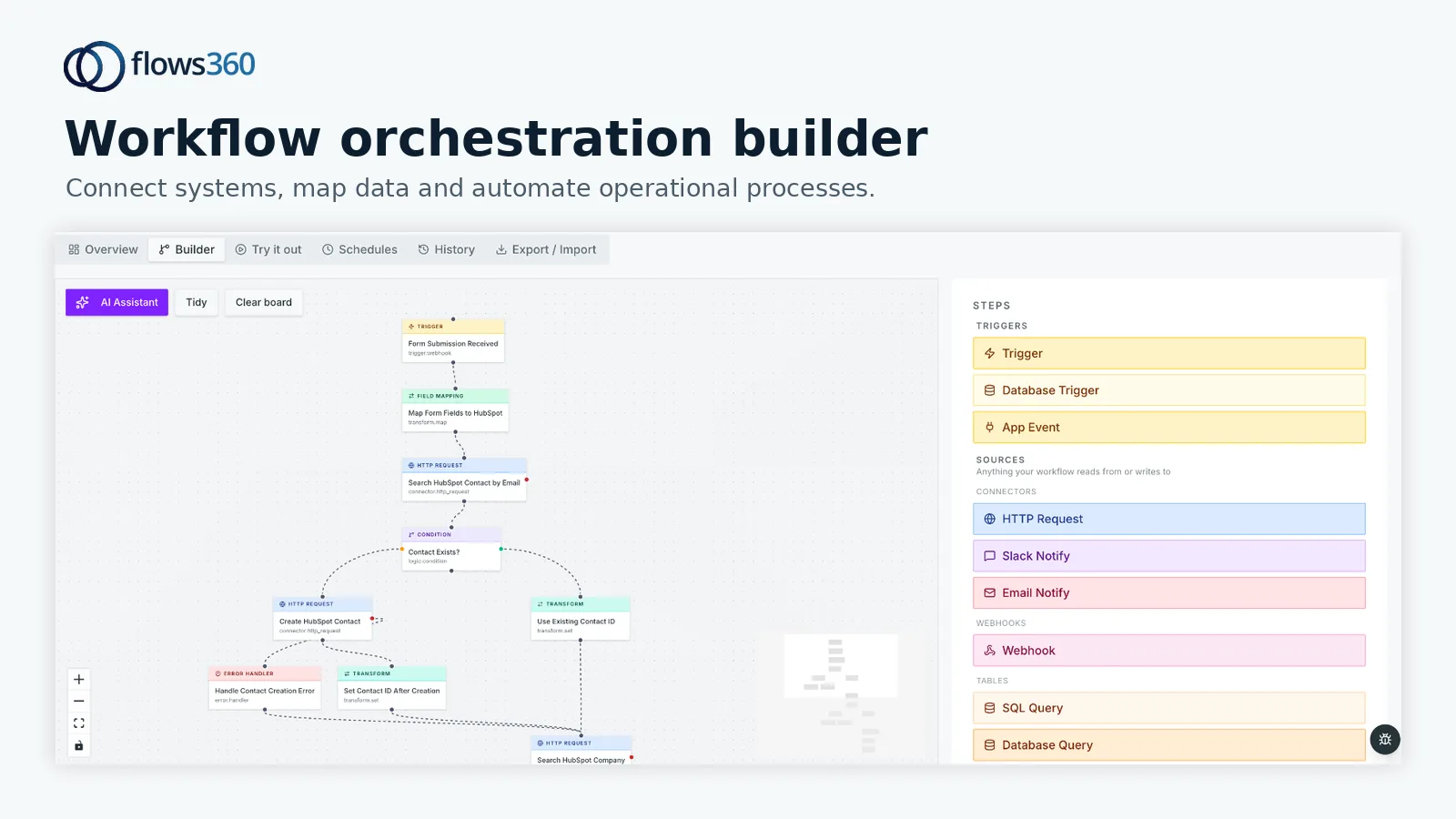
RevOps Platform vs. General Workflow Automation
This is important: not every automation tool is a RevOps platform.
General workflow automation (the kind you might build in a no-code tool) is great for simple stuff. Send a Slack message when something happens. Create a record in one system based on an action in another. Those tools are lightweight and accessible.
But revenue operations isn’t simple. You need orchestration across 5-10 systems simultaneously. You need to handle exceptions and edge cases. You need audit trails for compliance. You need rollback capabilities. You need to govern how data flows so finance, legal, and your CEO can trust the output.
A RevOps platform is built for that complexity. It treats data movement as a business-critical process, not a convenience automation. That means governance, deterministic execution, and visibility that your CFO can rely on.
How to Choose the Right RevOps Platform for Your Team

Start by mapping your actual pain points. Not what you think you should automate—what’s actually broken right now.
Is your issue deal velocity? (Deals are stuck in stages too long.) Is it data accuracy? (Numbers don’t match between systems.) Is it commission disputes? (Sales team can’t see how their comp is calculated.) Is it renewal management? (Customers renew but your team doesn’t know until it’s almost too late.) Is it customer churn? (You don’t see the signals until it’s too late.)
Once you know what’s broken, look for a platform that solves that specific problem well, not one that claims to do everything.
Here’s what to actually evaluate:
- System connectivity: Does it connect the specific systems you use? Salesforce, NetSuite, Marketo, Zendesk, Stripe, Tableau—whatever your stack is, the platform needs to reach it reliably.
- Governance and compliance: Can you define who can do what? Can you see audit trails? If your finance team needs to sign off on revenue recognition rules, can they do that inside the platform?
- Error handling: What happens when something fails? Can you set up alerts? Can you fix it without calling support?
- Scalability: Will this break when you’re moving 100,000 records per day? When you add five new integrations?
- Support for your process, not forcing a new one: The platform should adapt to how your team works, not force you to restructure around the tool.
When you’re evaluating options, look for a platform with strong operational pedigree—one built by people who have actually run RevOps, not just built generic automation tools. Flows360 is built specifically for this use case because that’s exactly what the founding team did before building the platform.
Implementation: Don’t Start Huge
The biggest mistake teams make is trying to automate everything at once.
Start with one painful workflow. Something that’s costing your team real time and accuracy right now. Maybe it’s deal handoff from sales to customer success. Maybe it’s commission calculation. Maybe it’s a churn risk detection process.
Get that one workflow running. See the impact. Build internal credibility. Then expand.
If you’re considering AI-driven RevOps features (like anomaly detection or churn scoring), start there with the same principle: pick one specific, data-rich problem first. Analyze lost deals. Look at churn indicators. Understand what your data is actually telling you. Build from that foundation before scaling across the organization.
Your RevOps structure and strategy should drive your technology selection, not the other way around. Make sure you have clarity on what you’re trying to accomplish before you implement anything.
The Real Outcome You’re After
At the end of the day, a RevOps platform does one thing: it makes your revenue operations predictable and scalable.
Right now, if you need to close a deal faster, your team might need to work late. Onboarding might slip. The process depends on people remembering to do things. That doesn’t scale. It burns people out.
With a RevOps platform, the process is automated. The rules are defined. The execution is consistent. Your team can focus on strategy and customer relationships instead of data wrangling.
For operations leaders managing fragmented systems and teams spread across sales, marketing, finance, and customer success, Flows360 provides the orchestration and governance you need to make those connections deterministic and auditable.
Common Questions About RevOps Platforms

What’s the difference between a RevOps platform and a CRM?
A CRM is where you store customer and deal data. A RevOps platform connects your CRM to everything else and automates what happens when that data changes. Your CRM is the database. The RevOps platform is the operational nervous system that moves data reliably between your systems.
Can I build this with Zapier or another automation tool?
For simple workflows, maybe. But most revenue operations have too many moving parts for lightweight automation. You need governance, error handling, audit trails, and the ability to handle exceptions. Those capabilities are built into RevOps platforms but not into general automation tools. The risk of data corruption or failed workflows is too high.
How long does it take to implement a RevOps platform?
A focused first workflow—connecting deal closure to customer success handoff, for example—can be running in 2-4 weeks. Full RevOps automation across your entire stack typically takes 8-12 weeks. It depends on how many systems you’re connecting and how complex your processes are. The key is starting small and building from there.
What happens if the platform goes down?
That’s why governance and error handling matter. A good RevOps platform will have monitoring and alerts so you know immediately if something’s wrong. You should have the ability to manually trigger workflows or step in if needed. And your implementation should not create a single point of failure where everything depends on the platform working 100% of the time.
See where your workflows are leaking time?